Showing posts with label PDP. Show all posts

Wednesday, 11 July 2012

Finding a sense of style

So as I've previously said, this summer is about trying to find a consistent style that fits into my natural ability and media i'm using. I've posted some things i've been doing but it seems that my "style" keeps changing although i'm starting to see reoccuring patterns coming through. With working in print I will be working with quite bold, graphic illustrations and so I've started to work in a more pattern/shape way that I really like the look of.
Here's some I did earlier:
Gal

Guy

One Flew Over The Cuckoos Nest - MacMurphy.

Frog

WIP
So like I said, I'm really happy with how these are turning out, I'm concentrating on shapes, shadows and shadesand think it works quite well. The only problem I keep thinking is that I haven't tried this style with any background illustrations, only portraits or similar. So that's my next challenge, I want to get a slightly more relaxed style of this for quicker drawings or full illustrations.

Like always any feedback is welcome!

Monday, 18 June 2012

Summer style

So since I last blogged, we had second year assessments (I passed) and am now an official third year student! SCARY!
As well as my dissertation (which I'll be blogging about at a later date) I have dedicated this free time to starting some personal projects and working on my "style". So here's a little update of what I've being doing with all this time off so far. . .

I started by looking around for some inspiration as to how I wanted to work. Primarily working in linocut I liked the idea of using patterns because I think that it shows up well in the print media but also has the ability to work in pen and ink for finer detail or shorter deadlines.
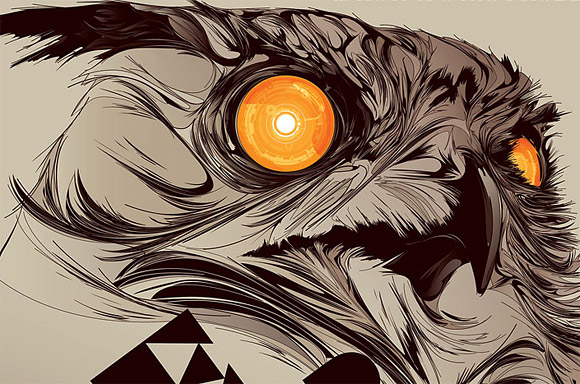
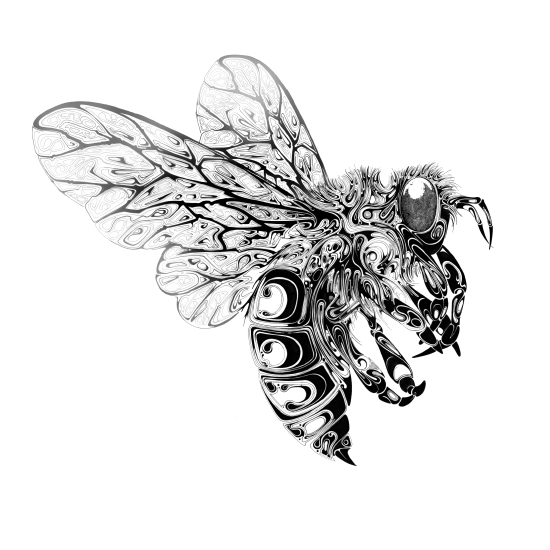
I drew inspiration from the likes of Swoon and Lynd Ward (who I've blogged about previously) as they work in the same media, but here are some other artists whose style I particularly like and want to try to draw from:
Kakofonia
Andreas Preis
Si Scott
Luke Dixon
So with these artists and styles in mind I began to sketch a few things like birds, other animals and tried some portraits to improve in that area too:
Crow study style test

James Dean Style test
Tiger style test
 I liked the way that these initial sketches had turned out and couldn't wait to try print in this way as I haven't really done anything particularly detailed with linocut. So with this in mind I began to do some more sketches and doodles with the possibility of taking it into print in mind whilst drawing it. This meant working at a slightly bigger scale, considering where bold black areas are and the contrast of the image, something I need to get into the habit of when working in linocut!
Skull style test
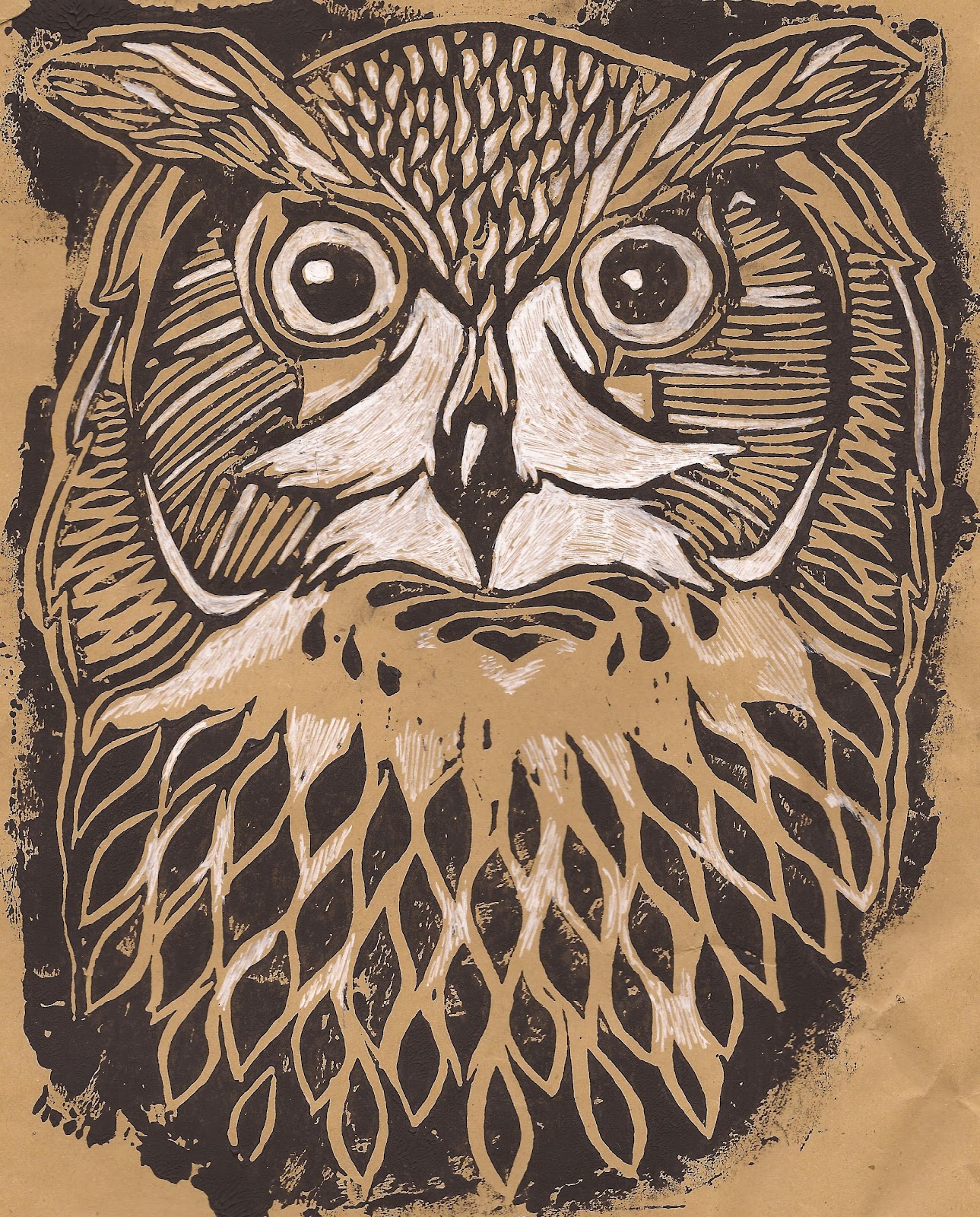
Owl style test in linocut
 I finally took one into lino, experimenting with different papers and colours and combining the dark lines of lino with adding white in certain areas. I'm quite pleased with how it came out and can't wait to continue to experiment with other images.
Magpie Colour style test

Red Panda Colour style test
So I've moved onto looking at how to use the patterns and bold blocks of dark lines that you get in print with a watercolour finish. Like I said I'm pleased with where my style is going and look forward to pushing it further throughout summer.
I'm currently turning my focus away from an animal subject to figurative and portraits in this style to see how it works and will post my results at some point! (Really this is just a procrastination exercise away from the dreaded dissertation but shhhh it's still productive!!)
Hope everyone's having a lovely summer! and any feedback etc. is always appreciated . .

Sunday, 29 April 2012

Money or morals?


 Before I came to university, I never really considered any legal or ethical implications of a career in illustration. Last year, we had two lectures that were about design ethics, and for me, it was a bit of a wake up call. Although I did at the time believe that it didn't necessarily have much to do with myself as an illustrator, in hindsight, I realise that post-university, I may be challenged with a brief that infringes on my morals. We all have things that we feel passionately about, whether it's something we think should be stopped or something we think should be accepted. It's important that we don't back down from those morals when faced with the challenge of money or morals. Obviously it's easy for me to say this, but I'd like to think I'd stick to my guns.

During creative futures, I went to a talk by a childrens illustrator who, although her style of work wasn't the way I work, and her work ethic wasn't necessarily similar to mine, I respected to work that she creates. She worked abroad by creating reading books for children in Africa, something that is making a difference.

For me, the best thing about my an artist is that we have the ability to communicate a message without barriers. Visual communication can break the language barriers that can hold back important messages, and so as well as thinking about facing moral dilemmas when accepting jobs, I'd also like to actively seek out jobs for this reason too. I have certain things that I feel strongly about, and have ideas as to how I can channel those feelings through my artwork, and so in the future, I hope to be able to create work that has a meaning to it. If there's one thing I could do by the end of my illustration career, it would be to create work that resonates with someone, makes someone think twice or even inspires someone. I realise that to some degree that's all that most people want to be able to do, but I definitely want to be able to say that I put my skill to good use over purely aesthetic reasons.

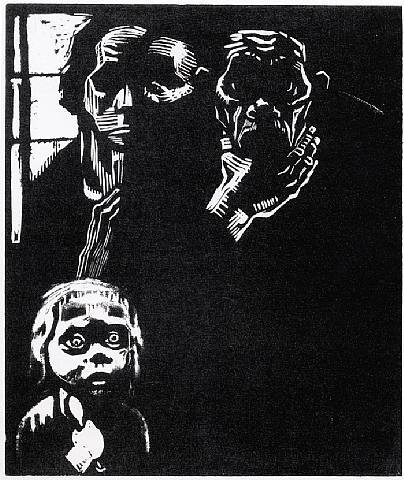
Branching from this, one of my favourite printmakers, Kathe Kollwitz, defintely inspired my want to be able to evoke something within an audience. As soon as I saw her work a few years ago, I immediately saw the emotion that she put into it. It wasn't until I began to seriously consider print and researched it that I linked her to it, but the way she uses the medium to convey the message and emotion that she wanted to, specifically her feelings towards the war that dramatically effected her life. She created a response to the First World War, in which she lost her son, to depict the grief that loved ones were left with post war. For me, this is what having an artistic ability is all about, being able to effect others with your work, although it would obviously be ideal to be able to make a living off of it too.

Kathe Kollwitz, Hunger.
Kathe Kollowitz, above and below two woodcuts from her series Krieg (War).

Friday, 27 April 2012

Fresh printmaking

As a follow up to my dissertation post, I wanted to do a post that briefly summarised my reasoning of picking my chosen subject, as well as some influences I had in getting there.
Since I started experimenting in the Print medium, I've discovered that it is predominantly linked to fine art, whereas I approach the medium from an illustration perspective. I'm not saying that there aren't successful illustrators who practise printmaking, but they tend to be outnumbered by fine artists. It also seems to be a medium that can often be overlooked, something I'm guilty of until I realised the error of my ways!
I've mentioned numerous times before in my blog that for me, print just seems to fit; something I find difficult to expand upon but i'll try. I started with print after being advised by my lecturer that she felt it was a media that would suit me and I should try it; so I did, and fell in love with it! For me, the fact that printmaking has so many options definitely appeals to me, that you don't necessarily have to be limited to one technique. I also like that print can be experimental, that you can stumble across an effect accidently but it works for the best. With print, I find myself wanting to try every technique, experiment, combine them and see what they can be used for and what they can't. It's a medium that i'm still learning but from what i've got at the moment, I think it's one i'm going to persue.
So hopefully my dissertation will help push this interest further and maybe even reflect into my work.

Here's some of the work I've found whilst conducting the initial research for my proposal:

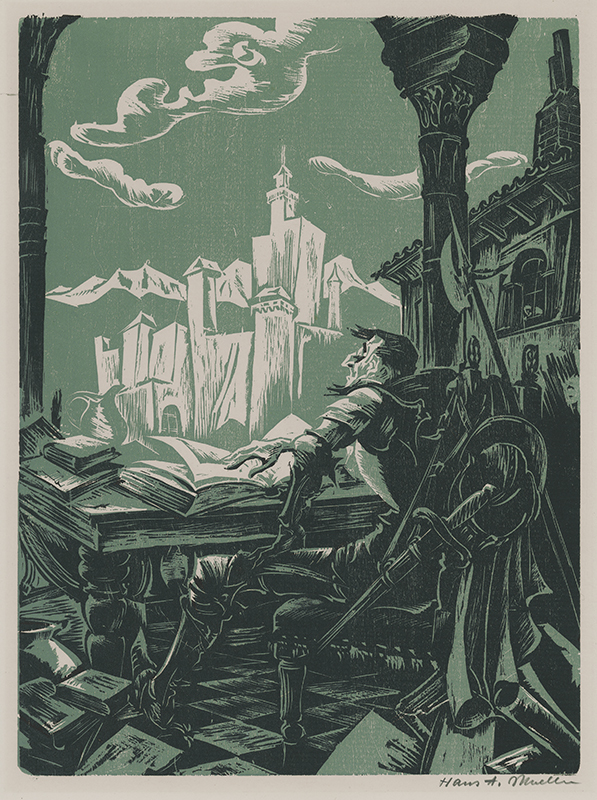
Hans Alexander Mueller:
 Although there are many exceptions (above and below being two!) I tend to think that many woodcuts/Lino can look dated when looked at in a modern sense. I love it when I find one that is timeless, a true sign of a master printmaker.

Lynd Ward:
AJ Masthay:


Although I haven't really ventured into colour yet with print, I think the  above example is incredible, to the point where it is almost unrecogniseable as a linocut. I like how Masthay creates such powerful images in all his work, something I aspire to do in the future.


Nick Morley:
Nick Morley may be better known as LinocutBoy, all his work is lovely and changes the way that print is often used. In the above example I particularly like how all the lines have a purpose, they're not just pieces that were left behind by the cutter but add to the detail of the face. I'm interested in using patterns with linocut, something that stemmed from seeing this image.

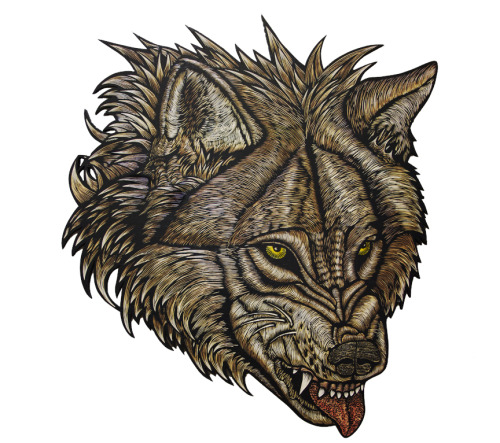
Wolfbat Studio:
Dennis McNett and wolfbat studios create very powerful images, obviously alot of wolves are featured, and like Masthays work, they can go to the point where it can be overlooked as a print. I think that just goes to show the skill in which these printmakers have, to be able to work the notoriously difficult medium in a way that makes it look flawless.

I think this goes to show that although I may not have discovered the style in which I want to work in print yet, I'm gradually taking bits from prints that I see and trying to apply them to my work.

Dissertation = Panic!

"5000 word essay" is perhaps the most awful words that can be said in art school, although with that being said, I don't mind an essay or two, given that the subject is right. And considering we get to pick a subject we are interested in, research into it and write about it, I'd say we've got it pretty good!

So I instantly knew my subject that I'd write about: Printmaking, I just had to narrow it down to a question that I wanted to write about. Now I chose print because I want to further my knowledge of it, but because of this, I'm finding so many things that I want to talk about and having a hard time to condense it down to a single thing. I wanted to avoid the typical "Digital Vs Traditional" debate or the question of whether Print is dead, simply because It's not and I'd be done in a few words.
So bypassing these subjects, I needed to find a topic that was about printmaking in Illustration as opposed to fine art, was interesting and taught me things I didn't know about print before. I mind mapped continuously, as well as constantly changing my question before I went down to speak to John the in house printmaker. He gave me some answers to the questions I would ask in my dissertation, and from our talk I left with a possible topic I could write about. The next generation of Printmakers - Will print die out with this generation? It sounds interesting already! I emailed my lecturer who knows print quite well, and asked for her opinion. Although she liked the idea she felt that I still had too many questions that made up the "bigger question", I already had a feeling that this was the case.

So at this point I'm trying to condense it down, narrow it into questions that are directly relevant and will discuss them with her later in the week.
At first when I started researching what it was I wanted to write about, I was quite determined to find a topic that wouldn't get bogged down with anything historical, something that I now realise was completely ridiculous! I panicked a bit when the tutor in charge of the dissertation mentioned Key theorists, to which I had none! This made me realise that in order to write a decent essay, with a good debate and critical analysis i'd need to put in some history. To my surprise it was there in front of me all along, there's a key text that my tutor advised me to read: Walter Benjamin's Art in the Age of Mechanical Reproduction, but I also realised that Bauhaus will play a massive part in my writing - I'm trying to prove that print can have a future in modern art, something that Bauhaus did when they took traditional methods and used them in modern ways. I need to research more into that over the summer but I believe it will work. I also want to go back onto the lectures we received earlier in the year about movements like the constructivists because they could also play a part in showing how print can be revived when put with a purpose.
On the whole I'd say that I have a good idea of what it is that I'm going to write about, I just have to make it more specific in order to fit into a 5000 word essay.
Researching this proposal has made me realise how difficult it can be to find things related to printmaking in Illustration - a point that helped me decide that my topic was the right one and had potential!
I'm looking forward to being able to link what I find out through my written research and putting into practise in my studio/professional work.

Sunday, 22 April 2012

Lesson number 1: Don't draw family!

After speaking to the printmaker at uni, and some of the speakers at creative futures, you need to always be drawing and improve your skills. Especially when i'm trying out a new (craft-based) media, keeping and building on my drawing skills is important. My goddaughter is getting christened next week and so I thought i'd take on a personal project to do a portrait of her and her siblings as a gift. Pressure!
Now I wouldn't say that I'm particularly good at drawing people, although I do have my moments and always willing to challenge myself to improve.


 I obviously had to gather quite alot of reference, and had to collect pictures separately so that it looked the best way. I actually enjoyed doing this project alot, even though I sometimes got frustrated because I was trying to get a similarity in looks, I learnt alot doing it. I learnt to step away from it after a certain amount of time spent on it and then go back to it instead of rushing it and to look at it in a different way. Something I should apply to my university work in order to get the best results.

I started out with drawing out the separate portraits before pulling them together over the light box, something that shows how university has made me approach things more professionally. I then coloured it using prismacolour pencils, something that I don't usually work with but worked best for the purpose of the project. This media let me experiment with colours, blending, tones and shades, something that I don't often think about when in print. I'm learning that just because you specialise in a particular area (print) it's useful to also be capable of working in others too for different jobs. Although I do like finding ways to integrate printmaking into my work in a way when it's suitable.


I then also reverted back into my comfort zone by using graphite and charcoal to produce a tonal portrait, just to see which worked better (I like to have options).


So, after many hours of debating whether it looks like them, alot of frustration and numerous changes, I finally reached a point where I felt enough was enough and that if I went further then it could turn out over worked (another thing i'm slowly learning through uni). Obviously it has its flaws, looking at it I sometimes prefer the line work as opposed to full colour, and it was never going to be super realistic due to the nature of my style but I am happy with how it turned out and the things i've learnt whilst doing it. Not sure as to which i'll decide to give as a gift but glad that it's finally done!

Monday, 16 April 2012

Trying to balance . .

. . personal work with professional (kind of) work. .

So this easter break I had quite a bit of work to get through. I had taken on two personal projects; one being a present (which i'll post at a later date) and the second being an antry for a local exhibition/sale.
The exhibition is put on in my local town by the church every year, where the local press and general public are invited to see artwork that's been submitted (in any media, of any subject) and even have the option to buy. In past years I've either lacked confidence to put something in or missed the deadline so this year I was determined, and with settling into printmaking, I wanted to be able to go against the usual traditional stuff that gets entered.
So I started off the two weeks that I had off by trying to get these finished (although maybe I should have done it the other way with uni work first) I also recognised that I couldn't do anything too daring considering the audience that were probably going to see it but I still wanted it to represent how I work. Like I said I wanted to take a spin on the usual entries of flowers, still life, landscapes etc and so I settled on an animal picture with a twist.
 Watercolour brick wall
 Linocut cat image printed on top.
 Coloured using watercolour.
Window frame detail added.
Paper doily added for window detail (net curtain)
 Finally I window mounted and framed it.
Named: The Inquisitive Visitor (mixed media - watercolour, linocut and collage)

The exhibition isn't until the beginning of May but i'm glad I finished it in plenty of time instead of leaving it until last minute (as per usual). The exhibition starts on May 7th until May 12th, if anybody is out there and wants to check it out it's in Mold St Marys church! 
(I'll post how it's recieved when the event has been!)

Creative futures . . done!

After blogging about the creative futures week we had, I realised just how much I had learnt; both good points and bad points. Although the majority of talks I went to were very informative and inspiring, some of the talks that we went to I didn't blog about, partly because I didn't want to be too negative when I didn't get much out of the talk. However I have been able to draw a few things from those talks that made me realise what I don't want to do and what I'd do differently (should avoid) in my career.
Along the way I have posted the advice that i've taken away from each talk but there was some general bits of advice that came up in more than one lecture.
  1. The Importance of social media - This was stressed in several lectures! We should be using social networking to get a foot in to the industry, it's that much easier (So to speak) to get yourself noticed today and we should be aware of that. That being said some also said that we should be careful what it is that we're putting out there and how. It can also be dangerous with it being so easy, only put work out there that you're happy with, that represents what you do. Be aware of your Internet presence.
  2. Don't be deterred - a career in the creative industries is going to be tough at times, especially getting started but don't back down, if it's what you want then push for it. Nothing worth having comes easy! 
  3. Be sure of what it is that you want to do - I was never a fan of doing this, I saw it as limiting myself and so I didn't want to settle into a style or a single media. But after going to some of the talks, I realised that the reason the speakers never achieved what they wanted was because they didn't really know what that was. Some didn't work in a distinctive style and therefore tended to blend in instead of stand out, something I don't want to do! So whilst I don't necessarily know what exactly I want to do, I know how I want to work and in what media. It's a start!
So that's the pieces of advice that were reiterated throughout creative futures week, although it's not all that i've taken from the week. This year I took creative futures a lot more serious than I did last year; this year I went to ones that may not be directly related but have relevance and therefore broadened my outlook to my work. I can honestly say that I can't wait for next year!

Thursday, 15 March 2012

For Sale: Baby shoes never worn. .

. . Ernest Hemingway once wrote a 6 word story. If you think that it's sad, then you made it sad. It's left open to the interpretation of the reader, is it a tragic ending or just a baby that's particularly picky when it comes to shoes?


Stories are so powerful that we lie, exaggerate and omit the truth in favour of telling a good story - Errol Morris. 

Everyone's a storyteller, whether it's the latest gossip, what you got up to at the weekend or the next bestseller, we all have stories to tell. For a long time I didn't see myself as a storyteller, as someone who loves reading and has an absolute ton of ideas that could be made into stories, it's the putting pen to paper and running from beginning to end that I struggle. This being said, we were presented with two new briefs in studio this week, one for the general illustrators (me) that was a competition brief under "Secret London" whilst the other was the MacMillan Children's book competition. I like a challenge so I've decided to go for the book option, but to do the London piece as a portfolio piece when I have time.

With an emphasis on storytelling in the briefs, we were given a little lecture on the fundamentals. In the lecture we were shown a TED talk of Andrew Stanton from earlier in the month, it was extremely useful.


Andrew makes the point that we as storytellers have an aim to make the audience care, we need to carefully consider characters, the plot, the messages that we send out through the story. He also highlighted the importance of the beginning of the story, where we make a promise to the audience that the story is worth their time. I particularly liked that he said storytelling has guidelines, not hard set rules*. Something that can be applied to most things, rules can be broken, as long as it's done in an appropriate way and purposefully. *See Hemingway quote at top of page!
Before I saw this talk, I was debating on which brief to take, the one set for me (the safe option) or the challenging children's book. After this talk I whole heartedly went for the MacMillan brief, I want to challenge myself, I want to be able to tell a story, I want to evoke wonder! Who doesn't?!

Kurt Vonnegut on the shape of stories.

Dan Harmon's Story Circles.
 Here's some of the tips I picked up today:
  • There needs to be fluctuation in a story to make it interesting.
  • You have to be aware of the problems you introduce in your story; every problems needs to be solved.
  • You have to mindmap all the possible ways your story can go in order to get the best possible plot; explore every possibility.
  • Write what you know! Draw from experiences.
  • Don't be afraid to tackle sensitive topics, it can be done!
  • Exercise your imagination!!
I want to tell story that inspire, are imaginative and carry a message. Although I do struggle to write a complete story, I feel that if I stick to these reasons for writing and I'm passionate about the subject then I'll be able to.
Like I said, everyone is capable of telling a story, you just have to find the story that you want to tell!

Sunday, 11 March 2012

So you want to be a printmaker . .

Working as a freelance artist (printmaking) by Ann Bridges.
Printmaking is definitely a medium that i've taken an interest in the past few months, I tried it out and instantly it appealed to me and my work. So I was a little sad that this was the only speaker in the week that was a printmaker!
Anyway, Ann spoke to us about her experiences at college, how she developed her printmaking technique into something unique and what it's like being a freelancer.
I was worried at first that this talk would lean more towards a fine art approach but once Ann had described this process, I instantly realised i'd gone to the right talk.


Ann briefly described her work process, that is based around monoprinting. Although it was hard to understand, not being able to see it, it's a stencil, monoprint technique where Ann experiments with cutting out the shapes and rubbing, wiping and layering in order to build up an image. This is what I particularly liked about Ann, she had gone through print and then adapted it to how she wanted to work, she hadn't just taken a traditional print technique and settled for the outcome but instead experimented and pushed the technique to become something that was unique and meant that she could create a more interesting style of work.
Since i've discovered working in print, i've tried out different methods in order to then take my favourite bits of them to use for different projects instead of specialising in one technique alone. I've found some that don't work well and others that I love to work in, and so Anns technique is something that is very good to see. Someone who has tried to push the boundaries of the print process by taking it further than the traditional methods. Printmaking isn't necessarily such a popular medium in this fast and digital time, and so I personally think that it's particularly important to refresh printmaking and make good use of its unique qualities.


I asked Ann whether she felt restricted in the media, something that I sometimes worry about, particularly after completing an editorial brief and questioning if such a long process of print would work in the quick natured industry. She explained that although you work in print, you need to find a method that can be adapted; something that I think i've already thought about. For example, Ann also has a method that combines illustrations with print should she need to work to a close deadline. I also think that when you build up experience in the chosen technique, you'll learn ways to work quickly whilst still producing a quality piece of work.


Although Ann did say that she wouldn't necessarily class herself as an illustrator, she uses printmaking for imagery not just to create patterns (which is what you mostly find in fine art methods etc) and so I can apply some of the things that she said into the way that I personally work. I want to continue to experiment in print, look into linocut in more detail and try out afew techniques such as reduction and multi block. I think thats one of the things that draws me to print, the fact that there's so many forms of it and new things that you can try.


Ann also gave us some advice: Get straight into work when you graduate, don't take the summer off! Give yourself time to experiment, things will go wrong and find new things, particularly for printmakers. You should constantly evaluate your work, be versatile, let the idea and process take you on a journey. Always keep a sketchbook, always look for work, use New Designers as a launch into the industry, and finally budget!!
Lots of things to think about! Overall it was a very useful lecture that has definitely got me thinking about the way that I work and how i'll work in printmaking in the future.

www.ann-bridges.com/

Friday, 9 March 2012

Lecture via Skype. .

Martin Steenton - Blank Slate Book Publishing:One of our lecturers set up a "Skype chat" with Martin because he couldn't make it up to the university in person. Genius! 
It was a very insightful talk, I made the most notes of any other talks I went to throughout the week! So this may take some time. .

Martin currently works for Blank Slate, a comic book publisher.
He started out studying media in Uni, not knowing what exactly he wanted to go on and do but he had a passion for comics and so started a blog, with his girlfriend, about french comics. Through the blog he built up contacts and was soon getting calls for him to feature more comics on the blog, from the US and even the UK. Through the blog he was given the opportunity to translate for Blank Slate. He told us how important it was to get the initial buzz around yourself, and how useful the internet is for that. He worked for free, but wouldn't advise us to do artwork etc for free, he was simply doing behind the scenes things that he enjoyed but didn't necessarily cost him anything. It gets your foot in the door of the industry, something that Facebook, Twitter, blogs, going to conventions enables you to do. You need to get on the radar of those already in the industry and that the more visable you make your work, the better.

Sleepyheads by Randall C
Blank Slate

Publishing a book is something that I would love to do in the future, both in graphic novel format and childrens publishing. So it was very interesting to hear what it is that publishers are looking for, that often publishers have different styles that they lean toward. Firstly, when you take your idea to a publisher, some will only look at finished work, they're looking for a complete skill set. Whilst the smaller presses, like Blank Slate, are more accepting. They're more focused on finding new talent, aslong as you have a good idea behind and they can see how you finish your work (media, technique, quality) then they will look at your roughs and decide from there if it has potential. This is also where making contacts can be useful, if you already have some form of relationship with someone from the publishers, talked through twitter/emails or met them at a convention, it can make a difference when you are pitching. I learnt that you have to tailor your submission to the publisher that you are pitching to. Advice that you can also use for your portfolio, you should make sure that what you are showing is relevant to who you are showing it to. In publishing terms, you need to research the style that the publishers usually go to and see if you think you'd fit it. If you don't you're showing that you haven't and you also want the best for your work, so it's in your best interest to find a publisher who will do the most for your idea.

A long day of Mr James Teacher by James Harvey
Blank Slate

He gave us a case study of sorts in the form of Daryl Cunningham, who had apparently been trying to be published for awhile before finally getting a deal. He became Blank Slates best selling book with Psychiatric Tales - proving that you should stick at it. If you are confident in your ideas and work then you should persist. Cunningham was prolific on Blogger and gained recognition from artists such as Scott McCloud. Something that Martin pointed out as very useful when trying to promote your work, established artists will often help (although there will be some exceptions). Send your work to thos who inspire you in order to get feedback, if they like it they'll often give you a quote that can be used for the book when it comes to promotion.

Copyright was also mentioned, something that definitely confuses the heck out of me! Although Martin broke it down pretty easily, there are different copyrights and you can retain the copyright by giving publishers a timed license that runs out and returns the rights to the creator after a period of time (often when the print stage is done). However if you have a character that the publishers or anyone else is interested then you surrender all rights when you sell them over. He made a point of saying that we should always be careful with what you sign, be fully aware of what you're agreeing too.


Jim Medway - Playing Out
Blank Slate
I particularly like this because it's a linocut! Inspiring indeed!
When talking about publishing, it was inevitable that we would discuss its future, with the rise in digital publishing. So, is there still a need for traditional publishers? Martin assured us that print would never completely die out, maybe take abit of a hit whilst ebooks etc rise but it would always remain. Print will always appeal to those who prefer physical media, for comic books/graphic novels in particular - the ebook market is not particularly appealing simply because they're not meant to be restricted to one format on a screen. Digital publishing also opens the door for piracy, something that is incredibly hard to control once digital sales are in place. I definitely agree with all that Martin said, I personally work in a book shop and e-readers have recently been introduced into our sales. Sales are steady (I even own an e-reader myself) however there are many hours that i've wasted talking to people about the e-reader, only for them to turn around and pick up a paperback before they head out. E-readers are popular but, particularly for the comic book market, print is still much more appealing.

So i'll finish on some advice Martin gave us. Don't - be arrogant, be difficult to work with, be unfocused, send stuff that is nothing to do with what they do, ask for honest feedback unless prepared for it.

Martins talk was very useful, to be able to see how being active on the internet and using it in a useful and creative way can  influence your career, and to see what it is that those in the industry are looking for from those who want in. After this talk it's also good to be able to see what exactly we are able to do, I never had an interest in comics before coming to university and attending talks similar to this one, which changed my perspective and realise that there's more to them than muscley superhero stories.

So go look at their website, they have some fantastic artists on the books!

http://www.blankslatebooks.co.uk/


Up next: Printmaking - Working as a freelance artist by Ann Bridges.

Wednesday, 7 March 2012

Sometimes I sit down to draw. .

but nothing comes out!

I have a ton of ideas that I want to get down on paper, but I sometimes get frustrated because I feel like I can't do them until i've refined my style.

So after Jonathan Edwards talk and advice, as well as feeling very inspired during this creative futures week, I decided to just put pencil to paper and draw, whilst thinking about my style. I know that I want to work in print, I usually work quite graphically, using various lines, weights and mark making techniques. I know what I want to do with print but I need to get my drawing stylised first in order to take it through print. I thought back to an exercise that my lecturer told me about not so long ago. He gave me a website, one that is made up of vintage photo's and he looks at the picture, finds particularly interesting people and draws them. I can't remember what exact website he gave me but stumbled upon my own in the form of Retronaut!

Give it a go, you will definitely find some characters!


Normal programming will resume shortly: Up next - Martin Steenton of Blank Slate publishing.

Tuesday, 6 March 2012

Character design and social networking. . .

by Jonathan Edwards.


I was definitely looking forward to this lecture, if there's one thing I love about Creative Futures, it's when graduates who have been in our exact shoes (so to speak obviously!) and to see that they've broken into the creative industry successfully and are still achieving new highs. Jonathan Edwards is a brilliant example of this.


Jonathan told his story in two parts, he started off with editorial and comic book work before investing in his Inspector Cumulus character that he accidently creating when flicking through his sketchbook. Jonathan said that he always had an interest in vinyl and collectable toys, and that is the direction that he saw his character going in. It just goes to show that you should trust your instinct, you know your creation just like you should know how much is too much, you should also know how far to push it.

Jonathan touched on the issue that i'm currently having, the fact that we just sit around waiting to be asked to do something, I feel like someone is going to come along and ask me to do a commission etc whereas it should be me going out and making myself known. And that is what he did, he took his character to Play Lounge, a company that aims to represent the latest innovative toys that aren't necessarily restricted to child play. From there he was connected to Crazy Label another company dedicated to toy manufacturing. Jonathan had a very hands on approach to the production of his toy, having constant feedback with the manufacturers, referring to his original design and concept and even designing the packaging too. This is something that is particularly inspirational, how he was dedicated to creating a toy that reflected his original idea and not become distorted when it easily could.

In both parts of his story, social networking had a huge part to play in the success of his work. For Inspector Cumulus toy, the popular blog ToysREvil caught on to it and created a buzz around the character. Jonathan advised that we should use Twitter in order to get our name know whilst still in Uni, so that come graduation you've already got a head start. Now this is something I wholeheartedly agree with, and do try to put into practice however that send button because awfully daunting when you're sending something to, maybe not the most famous illustrator, but someone you admire. It's something I'll have to get over, and hopefully will with confidence!


Second part of the story- Alongside his partner Louise Evans AKA Felt Mistress, he has produced window displays for Londons best retailers including Selfridges and boutiques. They play to each others strengths, Jonathan comes up with the character designs then Louise (magically) turns them into felt toys. He described their experience with working with Selfridges, being featured instore and the window displays. They seem a very hard working pair! I was amazed to see that all of their characters connect in some way, a sign of a well thought out and detailed concept.
They also got intouch with a Japanese agency in order to take part in a residency in which they would create characters, something that played to the cultural differences of toys being a much more popular market in Japan as opposed to here in the UK. This again showed that you shouldn't be afraid to approach people with work, especially if you feel passionate about what it is you do.

The thing I like most about Jonathan (and Louise) is that he stays loyal to his style. During some of the talks this week, you can see how the illustrator has changed their original concept so much in order to satisfy the client or designer, whereas Jonathan, even when dealing with big named clients, stuck by the way that he saw his character in order to create the best possible outcome. That is definitely something that we as emerging creatives should remember; stick to your guns!


So, the parting advice, was that you should draw inspiration from wherever possible. Jonathan told us that he draws inspiration from things around him; people observing in cafes, shapes, real people (sometimes well known).It's something that I like the idea of but never seem to getting round to it or never have my sketchbook to hand, maybe i'll try to better myself during the summer. But the inspiration part has changed the way I look at things, I try not to close myself off to things, always listening to what people are seeing and if it can be used in some way, drawing and making a note of things that inspire me or ideas that I have so that I can revisit them in someway and some point.
He shared that he was once told that you either draw realisitically, with proportions etc or you draw using shapes, and the more I think about it, the more it makes sense. He said that for him it was a lightbulb moment and he suddenly realised that he had been doing it wrong the whole time, then turned his focus to shapes. I feel like he's triggered my own lightbulb moment, hopefully, so we'll see how it goes!
You have to get through the bad in order to improve, so the next time i'm sketching something and it looks awful, i'll finish it before I cry! This is something that I need to realise, I expect everything to look perfect the first time I do it, which is obviously not going to happen but I should learn from it and do it better the next time. Keep a sketchbook, set yourself goals, connect through social networks. For me, it just shows that if you find something unique, have good ideas and execute them well, abit of self promotion and you'll go far!
This talk also made me think about collaborations, its obviously had a positive effect on both parties work, one compliments the other and it goes to show that if you find the rightwork that influences/compliments yours then it can be beneficial. It's something i'll consider in the future.
A thoroughly enjoyable lecture, and dare I say, the best one yet (who cares if its only Tuesday!).

 All images belong to Jonathan Edwards - www.jonathan-e.com/


"I like to draw dead things" . .

Illustration and animation by Karen Cheung.

I'd googled Karens work before the lecture, to see what was in store and fell in love with her quirky style. She opened by saying that she initially studied zoology at Cambridge before trying again with illustration, a theme that is definitely reflected in her work.
She went on to show us an animation she had made, Headache Hotel, which can be viewed over at http://www.karencheung.co.uk/animation/animation.html.. along with other animations!
She has also made a childrens book, Shleepless, a book about a young boy having trouble to sleep, heavily ininfluenced by French picture books. However the unusual underlying tone, even though she won the macmillan prize! has left publishers unwilling to publish it with concerns that it may frighten children. Personally, I absolutely love what I've seen, the quirky concept, the mixed media techniques used throughout the book and the overall look, it's something i'd love to see on the shelf in work! I admire that Karen Cheung has pushed the boundaries of what is accepted as a childrens book in Britain, and glad that she hasn't conformed in order to get a deal. I hope in the future publishers come to their senses!


Karen got an agent soon after graduating Bristol University, and said that when putting your portfolio together you should consider what it is that you want to do; if you want to do editorial, they want to see people etc, concise, and that you should have different portfolios if you work in different styles. Karen didn't wait around for the jobs to come in but instead took her portfolio and went door to door in London to see if anyone liked her animations, before getting a call from 12foot6, fitting into their in house style and working there for a couple of years. This self promotion, to me, seems terrifying, I obviously need to become more confident in my work!


Karen also gave some insight into what it's like having an agent, that it helps to be versatile, to stand out from what others are doing, and that the downside is that you sometimes get passed work that you wouldn't normally take. This is where I begin to frown, simply because Karen has a style that is incredible and although that only my opinion, I can't be alone in. She showed us some work that she has completed through the agency and I can't help but think that maybe she was being a little too versatile. Some things she described as "not even remotely similar" to what she usually does, and she didn't seem as passionate about it as when she was talking about her animations or her book. Obviously i'm aware that it's easy for me, a clueless and naive student, to say that you shouldn't take on the jobs that mean you change your style. I understand that when the jobs there and you have grown up stuff to take care of, you're going to take it, however i'd like to think that i'd only do it to a certain extent. My style is the way that I work (although i'm still working on it) take it or leave it. . . I say that now and i'm sure if you check back in a year or two and i'll be drawing god knows what for god knows who!! Or something . . 

Like those before her, Karen finished by giving some needed advice: Work hard, trust yourself, listen and have fun. Explore, don't restrict yourself. And after graduation, be brave, work even harder, persevere and don't take it personally. Always be critical, it'll help you produce the best quality of work. Oh and apparently TAX is important! All gems that know doubt i'll forget. .

So, for me, Karen was definitely the highlight of the day. Her work just clicked with me, she seems like a lvely person and her ideas and the way she works is inspirational. I like how she has combined her illustrations with animation, something that I would like to look into in the future, although I don't think it would be a way in which i'd consistently work, but I do have a few ideas in which animation would be a possible way of communicating it. All in all, a wonderful guest speaker!

All images belong to Karen Cheung,  http://www.karencheung.co.uk/index2.html

Up next: Character Design and Social Networking by Jonathan Edwards.